
Europe’s airlines are cutting costs. But are they built for permanent disruption?
This analysis is an excerpt from the AAP Aviation Perspective, our biweekly newsletter on LinkedIn where we explore the key strategic issues facing the aviation industry.
At the CAPA Airline Leader Summit in Berlin this April, the framing from the room was clear and unsentimental. Disruption is no longer occasional. Volatility is now embedded in daily operations and long-term planning.
Six years after the pandemic, the industry is no longer recovering back to a stable baseline. Every time the industry has looked for a return to stable, predictable operations, the next shock has arrived.
Then, in slightly different words from another speaker:
"We can hardly influence cost, so we focus on revenue."
In an environment where disruption is now the operating reality, the question is no longer only how airlines protect revenue. It is whether the cost structure behind the operation is still built for the market they now face.
European aviation has spent the last decade getting very good at revenue and introduction of commercial models. Every revenue lever has been redesigned, often more than once. The cost side has not had the same decade. It has been managed inside operating models that were broadly stable well before the current shocks began.
Cost shocks are no longer external - they are now operational
A week after CAPA, Michael O'Leary issued his sharpest warning of the year. Two or three European airlines, he said, could go bankrupt before the end of 2026 if fuel stays elevated. The leader of one of Europe's most cost-disciplined airlines was not warning about his own balance sheet.
Around two million seats were pulled from May schedules globally. Air France-KLM has flagged a $2.4 billion additional fuel cost for 2026. Lufthansa Group has flagged €1.7 billion.
Both groups have hedging in place. But the scale of the fuel hit shows how quickly external cost shocks can move through even well-prepared carriers. The point is not that airlines are unprepared. The point is that even prepared airlines are now absorbing shocks large enough to expose the limits of optimisation.
This is not a cyclical squeeze. It is a re-pricing of how Europe flies. Brussels is looking at the same changed environment from the policy side. On 23 April 2026, the European Commission opened a call for evidence on a new EU aviation and aerospace strategy, citing rising energy costs, geopolitical tensions, supply-chain disruption and stronger global competition.
This is no longer only an airline boardroom discussion; Europe’s aviation framework is also being reopened because the environment around it has changed.
When cost programmes land and the margin gap stays open
None of this is happening to airlines that ignore cost. It is happening to airlines that have been working on cost for years.
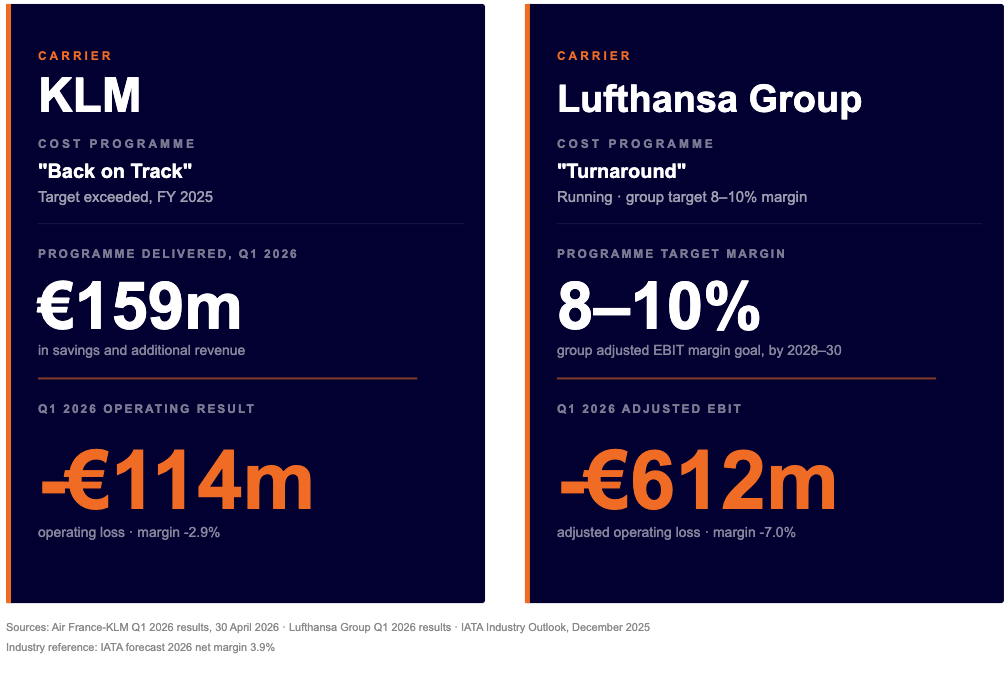
KLM Royal Dutch Airlines launched its "Back on Track" programme. In Q1 2026 alone, the airline reported €159 million in savings and additional revenue. KLM still posted an operating loss of €114 million in the same quarter. CFO Bas Brouns put it directly in the airline's annual results: costs are rising faster than revenues, leaving the airline vulnerable and requiring structural decisions.
Lufthansa is in a similar position from a different starting point. The group's Turnaround programme targets an EBIT margin of 8 to 10 percent by 2028 to 2030. In Q1 2026, the group posted an adjusted operating loss of €612 million, an adjusted EBIT margin of minus 7 percent. CEO Carsten Spohr framed the year ahead in his own words: the crisis, combined with rising fuel costs and operational constraints, poses enormous challenges for the company as well as for global air travel.
These are not airlines failing to act. These are airlines acting hard and absorbing shock after shock within their existing structures.
When a cost programme lands on plan and the margin gap stays open, the question is no longer programme execution. The question is whether the programme is built for a world where the shocks do not stop.
Optimising costs is not the same as changing the operating model
The problem is not lack of discipline. It is that the cost base is being managed inside an operating model that has not been structurally redesigned in decades.
There is a meaningful difference between tightening the lines inside a cost structure and asking whether the structure itself is the one the airline should still be operating. One is finance work. The other is operating model work. Most European legacy carriers continue to do the first while treating the second as fixed inheritance.
Ryanair operates from the inverse logic. Speaking with Nicolai Tangen, CEO of Norges Bank Investment Management, Michael O'Leary described Ryanair as a business built around continuous cost transformation. Cost is not a residual added after the commercial plan is set. It is the starting point of the operating model.
This is not a low-cost versus full-service debate. It is a question of where the cost question sits in the design hierarchy.
Europe’s cost pressure is not evenly shared
European carriers are not under a generic global cost pressure. They are under a specifically European one.
EU regulation continues to tighten on emissions and labour. Airspace restrictions cascade through European route networks. Labour now accounts for around 28 percent of industry operating costs, with wage growth outpacing inflation across most major European markets.
CAPA's mature-market diagnosis is direct. Europe faces regulation, infrastructure pressure and slower demand growth. Asia and the Middle East absorb the share of global expansion, with roughly 60 percent of future global traffic growth expected to come from Asia.
As long-haul demand keeps shifting eastward, route-level economics on Europe to Asia sectors will increasingly be shaped by carriers operating from a structurally lower personnel and operations cost base. IndiGo's long-haul expansion is the most visible signal. European long-haul margins are the first line that absorbs that pressure.
European carriers can keep tightening line items. They cannot indefinitely tighten line items while the operating model that generates those line items remains untouched. And the shocks are not stopping.
" Disruption is permanent. The airlines that win will be those with structurally flexible cost models,"says Fredrik Strand Randgaard CCO at AAP Aviation.
"The question is what airlines are actually willing to change."
That is the question European cost programmes might not be designed to answer.